By Hinman Straub
New York Governor Kathy Hochul delivered her State of the State address Tuesday, January 13th. The Governor spoke from the Hart Theater at The Egg in the Empire State Plaza. The speech is the Governor’s fifth such address since becoming Governor in August 2021.
The New York State Constitution requires the Governor to deliver an annual message to the Legislature regarding the “state of the state.” The proposals outlined in the State of the State are the first step in defining the Governor’s agenda for the coming year. Her policy and funding proposals will be forthcoming in the Executive Budget, due January 20.
The Governor’s speech highlights her administration’s priorities for the coming year and calls upon the Legislature to focus on affordability measures.
Key proposals of the State of the State address include the following:
Agriculture
Governor Hochul will expand support for dairy farmers by advancing another round of the Dairy Modernization Program and extending the refundable investment tax credit to give farms the time and certainty needed to modernize operations and complete major projects.
In addition, to address issues caused by federal tariff policy, Governor Hochul is proposing the Agricultural Resiliency Against Tariffs Program, which will provide $30 million in direct payments to New York specialty crop growers, livestock producers, and dairy farmers.
Governor Hochul will introduce the Sun and Soil Program to increase options for farmers to benefit from the integration of solar energy development on their land while maintaining valuable land assets. The program builds on existing State-supported research and demonstration projects that show how solar panels can be co-located with active farming, such as grazing and crop production, allowing farms to generate clean energy while keeping land in agricultural use.
Affordability
The Governor’s address focuses largely on affordability through the provision of childcare, a focus on increasing auto and home insurance costs, rising utility costs, increased rent protections, and food and nutrition benefits.
Governor Hochul is proposing a series of reforms targeted at combating fraud and bad actors, to lower costs while ensuring victims are entitled to justice and restitution. Such reforms include various actions designed to crack down on fraud and strengthen anti-fraud programs, limiting damages for individuals engaging in unlawful behavior at the time of an accident and for individuals who are “mostly” at fault, and tightening the serious injury threshold, among other proposals. This proposals dovetail nicely with NEAFA priorities.
Much of the Governor’s affordability message revolves around rising utility costs. The Governor includes many proposals aimed at curtailing rising utility costs, including omnibus legislation that will try and tie executive compensation to affordability benchmarks, requiring utilities to present budget-constrained options during rate proceedings that keeps their operating and capital costs below the rate of inflation, a DPS review of utility bills to ensure ratepayers only pay for appropriate and approved costs. The Governor also proposes to fund the EmPower+ Program with an additional $50 million. The Governor intends to require data centers to pay for the costs associated with the additional utility infrastructure to power operations – or – to provide their own power.
The Governor will also introduce legislation that will require utilities to create and report on an affordability index, showing the energy burden on customers throughout their service territory. The Department of Public Service will report on utility affordability by utility, benchmarked against data from other states, and make an annual affordability presentation to PSC. If the PSC finds that any utility in New York is failing to protect energy affordability, this new legislation will empower the Commission to install an independent “Affordability Monitor” who will have full access to management meetings, books, and records to review utility operations and expenditures to help ensure efficient spending and report opportunities for cost savings to PSC.
The Governor will also put forward transparency measures for rate case proceedings, making various reforms to the current process.
In 2026, Governor Hochul is putting forward a plan to achieve “universal, affordable childcare.” This includes a new investment in Agri-Business Child Development (ABCD) Centers. The Governor's investment will increase funding by $1.7 billion on top of the significant increases previously made, and make a down payment towards ensuring statewide universal access to prekindergarten for four-year-olds (“Pre-K”), supporting the State’s early childhood workforce, and partnering with New York City to launch a 2-Care program for two-year-olds and finally realize the promise of universal access to 3K in New York City. This funding will support counties to build out new demonstration projects that offer universal care, reaching tens of thousands of more families with vouchers for affordable care. Alongside these commitments, the Governor will launch an Office of Childcare and Early Education to steer the implementation of high-quality, universal childcare for New York families.
The Governor is offering several proposals aimed at lowering rising home insurance premiums including, tracking home insurer profitability and requiring insurers to lower rates or justify premiums for carriers with more than two consecutive years of “outsized profit margins.” The proposals also include transparency measures, expanding automatic discounts for homeowners and commercial multifamily properties.
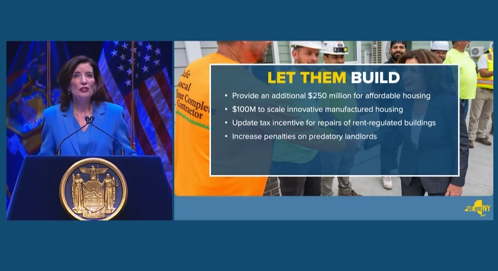
The Governor will put forward measures to increase protections for renters including enhancing penalties to protect rent-regulated tenants from pervasive harassment, reforming the J-51 tax incentive that can better support capital repairs for New York City’s rent-stabilized housing stock and streamlining the process, and expanding the SCRIE and DRIE programs.
The Governor announced several proposals to help needy families with food assistance and benefits including by supporting food banks and pantries with capital expenses, fighting fraud in food benefits with modern EBT cards, and supporting SNAP and meal programs.
Consumer Protections
Governor Hochul proposes to create the Office of Digital Innovation, Governance, Integrity, and Trust (“DIGIT”). DIGIT will serve as a central, authoritative body for digital safety and technological governance, devising new approaches and ensuring consistent enforcement to keep New Yorkers safe online.
The Governor will advance legislation to require all data brokers operating in New York State to register with the State as data brokers, and to allow New Yorkers to submit a single, centralized request to have certain categories of personal data obtained by data brokers deleted.
The Governor proposes to advance legislation that requires AI-generated content to include labeling about its origins and creation. Called “provenance data,” this information may be used like a digital nutrition label, allowing people to better understand more about where content comes from.
The Governor will also advance legislation aimed at cracking down on fake online discounts by codifying existing federal rules that require discounts to be “bona fide,” or genuine, and represent an actual discount on a regularly offered reference price.
Economic Development
New York will launch a downstate-based Semiconductor Chip Design Center. This initiative will focus on complementing chip manufacturing infrastructure upstate. The Center will be a world-class chip design facility, serving as an incubator for early-stage firms, training chip designers, and connecting startups to the larger semiconductor sector throughout New York State.
New York will also establish up to four quantum hubs across New York that will serve as incubators and foster the development and commercialization of quantum technologies. These hubs will be regional anchors for quantum innovation, prioritizing commercialization of new inventions and real-world use cases. Each hub will host an incubator for quantum-focused startups, providing early-stage companies with critical resources, including mentorship and access to local quantum networks and quantum computing.
The Governor proposes to launch the Bolstering Biotech Initiative which will support all phases of the life science sector pipeline, from discovery to commercialization. These investments will accelerate the commercialization of life-changing therapeutics—with a focus on neurodegenerative disease—and catalyze private investment in biotechnology research and development through the following programs:
· Statewide Clinical Trial Consortium: Establishing a statewide clinical trial consortium to leverage the combined strengths of New York’s research institutions to expand access to cutting-edge therapies and position the state as a premier destination for medical innovation.
· Venture Capital Investments: Leveraging public and private venture investment to support promising startups with the potential to mature into the next generation of industry leaders.
· Fellowships and Workforce Development: Seeding new skills-training programs designed to equip New Yorkers with the necessary skills to fill high-demand roles from production to c-suite in the biotech field, opening pathways to high-paying jobs for New Yorkers.
· Commercialization Grant Program: Creating a new, performance-based grant program modeled on the state’s successful Biodefense Commercialization Program to support companies in bringing biotech innovations to market in targeted areas such as neurodegenerative diseases.
Environment
The Governor is proposing a number of environmental initiatives, including $425 million in funding for the Environmental Protection Fund, another round of funding for the Green Resiliency Grant Program, flood and coastal resiliency funding, and clean water initiatives.
Energy
The Governor will advance a new initiative, the Nuclear Reliability Backbone, directing state agencies to establish a clear pathway for additional advanced nuclear generation to support grid reliability. The Nuclear Reliability Backbone will be developed by a new Department of Public Service (DPS) process to consider, review, and facilitate a cost-effective pathway to four gigawatts of new nuclear energy that will combine with existing nuclear generation and the New York Power Authority's (NYPA) previously announced one gigawatt project, to create an 8.4 gigawatt “backbone” of reliable energy for New Yorkers.
Governor Hochul will support legislation to establish a sales tax exemption on the retail sale of electricity used to recharge an electric vehicle by a commercial EV charging station.
Manufacturing
The Governor will launch the Manufacturing Modernization Program to support the state’s small and mid-size manufacturers. The program will establish a network of Centers across the state, focused on assisting small and mid-size manufacturers in adopting new technologies. These Centers will provide such support as technical assistance to small manufacturers as they incorporate AI into their operations, supply chain consultations to help businesses adapt to geopolitical and tariff impacts, and capital grants to help manufacturers modernize equipment or pivot to priority sectors, such as clean energy.