FDA Breaks Up With AAFCO

Charlie Elrod, Ph.D., Vice-President, NEAFA

In just a month from now, the eighteen year-old Memorandum of Understanding (MOU) between the Food and Drug Administration (FDA) and the Association of American Feed Control Officials (AAFCO) will be coming to an end.  Since 2006, this MOU has provided the framework under which the FDA provided scientific and technical assistance to AAFCO in the process for feed ingredients to either be accepted through the animal food additive petition or to be generally recognized as safe for use in livestock feed or pet food.  This breakup does not affect any ingredients which are already defined in the annually published AAFCO Official Publication but will certainly slow down the process for any new ingredients to be approved.  

This seems a bit ironic after AFIA successfully lobbied, in two different federal budget years, for the addition of significant funding to increase technical staffing within FDA to accelerate the process of feed ingredient reviews.  However, the need to revamp the food ingredient approval process is driven by activist activity, potential litigation and a lack of transparency in the process.  We witnessed this pressure last year when a bill was introduced in New York State which would have charged NYS Department of Ag & Markets with developing its own food/feed ingredient approval process.  This would have been a difficult mandate for Ag & Markets to fulfill.  NEAFA lobbied effectively against this bill and it eventually died in committee.  

The FDA has established a comment period for the public to register their thoughts on changes needed to promote the efficiency of the feed ingredient process.  If interested, you can submit comments here.  Comments will be accepted until midnight on December 9, 2024.

The process of approving GRAS feed ingredients was changed several years ago to a system whereby firms or individuals can notify FDA of their own determination that a substance is GRAS based on their own data.  However, FDA must still review the application’s merits and will issue a “no questions” letter if they believe the data to be consistent with a GRAS designation.  Effective September 1st, FDA will stop accepting new Food Additive Petitions and GRAS applications in order to give them one month to clear pending applications before the October 1st end of the MOU.

FDA has published a draft for a new Animal Food Ingredient Consultation process which outlines the ways in which companies developing animal food ingredients can consult with FDA following the demise of the MOU with AAFCO.  They are accepting comments on this process as well.  

As you know, NEAFA collaborates very closely with AFIA. Louise Calderwood and Leah Wilkinson are seeking input from AFIA members and will be providing talking points and a letter template for AFIA members to use.  While making our individual comments to FDA via the link above will be useful, it will also be very worthwhile to provide comments to AFIA where they can summarize them and effectively lobby as the voice of the feed industry.  Comments to AFIA can be submitted here.

This is a very important issue for our industry and one that we will stay closely attuned to.  As more information becomes available, we’ll be sure to share it in the NEAFA newletter or in email blasts to members.

Golf for Good Works Tournament Results

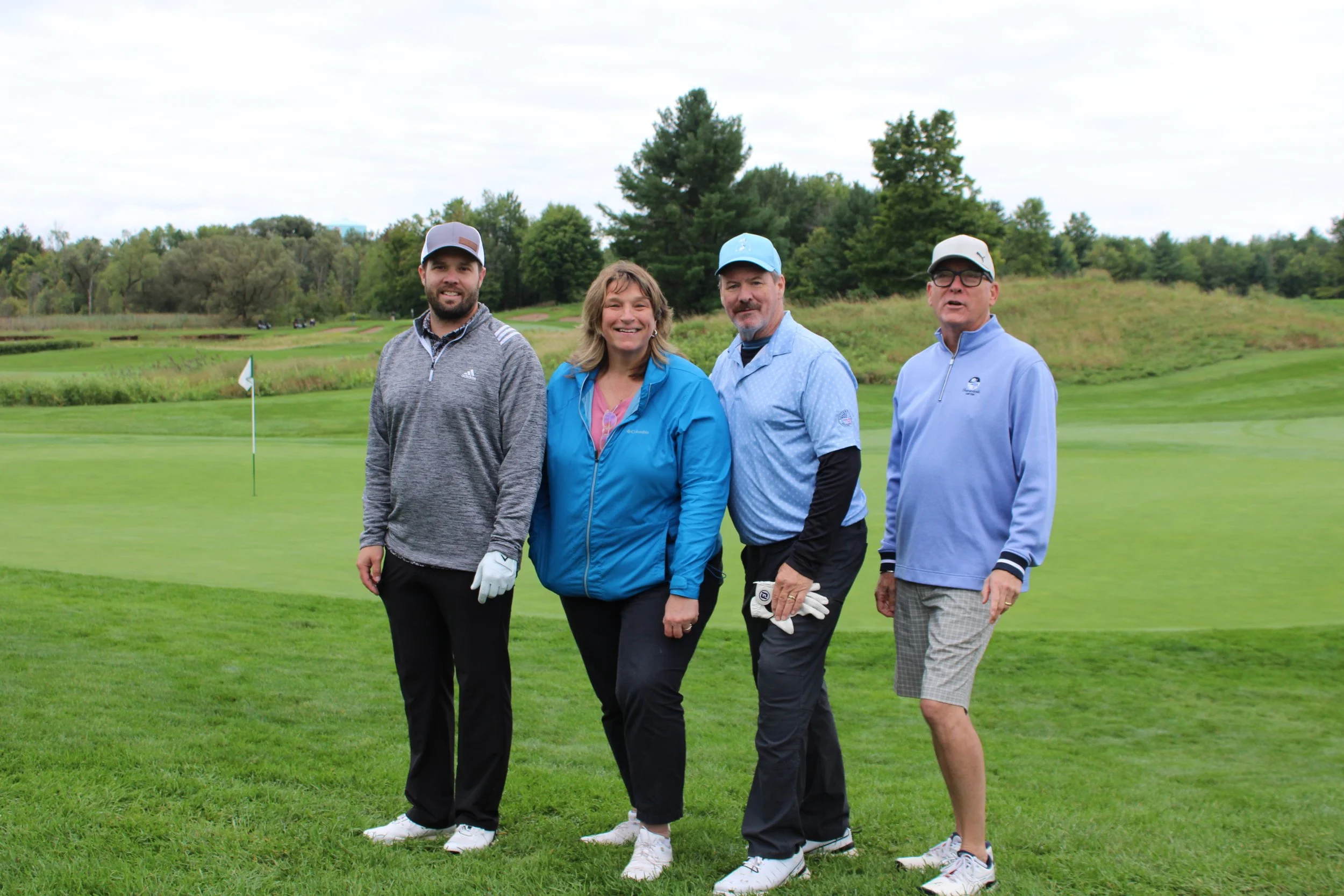
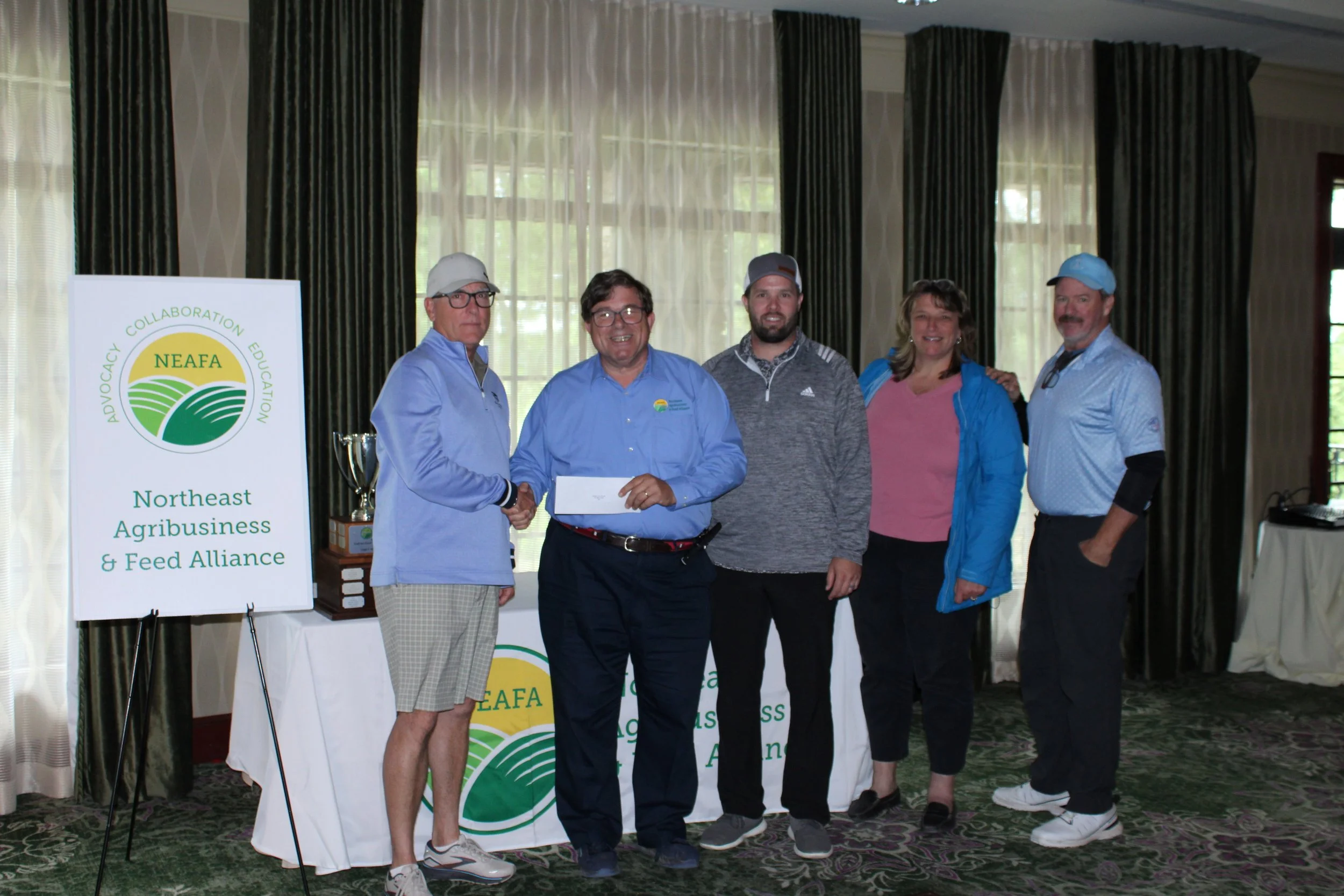
NEAFA would like to congratulate Co-Operative Feed Dealers team of Tom Buck, Dave Horn, Julie Bowman, and Josh Lincoln on their first-place win (-13)

The Golf for Goodworks Tournament returned to the Turning Stone Resort’s Shenendoah Golf Course for 2024. Shenendoah offers 18 holes of PGA-level golf in a picturesque nature setting. The course complies with stringent Audubon International standards for environmental protection and preservation. Designed, constructed and maintained to TOUR standards at more than 7,000 yards, the course offers conditions normally reserved for Tour professionals.

NEAFA would like to congratulate Co-Operative Feed Dealers team of Tom Buck, Dave Horn, Julie Bowman, and Josh Lincoln on their first-place win (-13). Second Place went to Harbor Point Minerals’ Nick Stacy, Steve Dearstyne, Justin Baldauf, and Dan Ward (-10), while third place went to Bonnie Bargstedt, Adam Robertson, Shane Laurie, and Matt Robso (-9). Brad Abrams was the closest to the pin at 8’, 7”, and Don Powell held the longest drive. The highest score (aka the Most Honest Team) went to Global Agri-Trade Corp.’s Barry Baetz, Dave Brown, Mike Liddle, and Kevin Howe (+13). Thank you to all who participated this year.

Proceeds from this event goes to support agricultural education and outreach programs. Previously NEAFA has supported the Northeast Regional Intercollegiate Dairy Challenge, Future Farmers of America Foundation, NYS 4-H Foundation's Junior Dairy Leader Program, the New York State Fair Dairy Cow Birthing Center, LEAD New York, Dairy Judging Teams in New York and New England, New York Farm Bureau’s Food & Farm Experience, Maine 4-H Foundation's Dairy Quiz Bowl, and the Growing Through Showing Program.

Increasing Consumer Advocacy at the Dairy Cow Birthing Center

By Jenny Mills, NEAFA President

For the past eleven years, New York Animal Agriculture Coalition (NYAAC) has hosted the Dairy Cow Birthing Center at the New York State Fair.  Literally, hundreds of thousands of people come to the large white tent at the West end of the fairgrounds to watch the birth of a calf and ask any question about agriculture and production practices to a group of volunteers, including many members of NEAFA.  I had the opportunity to volunteer my first shift this year.  I always leave energized about ag advocacy because of the many wonderful personal conversations we have about the dairy industry to consumers.  Some quick observations from my time there:

  • People are curious.  I found that the average conversation lasts several minutes, peppered with lots of questions about not only the calving process, but farming in general.

  • Most people appreciated the information and the fact it came from someone in the industry.

  • If you are curious what the most frequently asked question is – I would guess it is a tie with “When will the next cow calve?” (I always laugh and talk about the inability for me to predict Mother Nature’s work….. then talk about the signs of calving) and “Why do you remove the calf from the cow?” (Great opportunity to talk about animal safety, ensuring calf and cow get the care they need and make sure the calf gets colostrum)

  • Nothing fills a tent faster than the text message of “a cow is in active labor” does!  NYAAC has a text message service that will alert fairgoers when a cow’s water breaks.  Hundreds of people generally come back to the exhibit and are greeted by the dairy producer or industry volunteer that talk about the birthing process, along with positive messages about agriculture – good for the land, animal welfare, positive benefits of consuming dairy products and the overall positive impact of agriculture on the economy.

This year, NYAAC unveiled a new interactive dairy experience at The New York State Fair on Monday, August 19. This new Mobile Dairy Experience features state-of-the-art technology, captivating imagery, and immersive activities for all ages.  Several videos are part of the experience, showcasing family farms of all sizes, manure application and methane digesters, interviews with employees and exploring robotic milking technology.  Other sections of the trailer review the journey milk makes from cow to table and a deep dive on many dairy products.

The 53-foot, double-expandable trailer is “driven by New York dairy” and was made possible with support from family dairy farms and agriculture partners across the state, including funding provided through the New York Dairy Promotion Order Advisory Board.  The trailer would make a great addition at local fairs, open farm days and other venues where consumer education is the focus.  Check out the NYAAC website for more information: Mobile Dairy Experience | New York Animal Agriculture Coalition (nyanimalag.org)

If you are in Syracuse anytime now through Labor Day (Sept 2), come say hello to several of our board members who volunteer at the Birthing Center!  A visit and volunteering are very positive experiences as we advocate to the thousands of consumers who attend! 

The new Mobile Dairy Experience trailer features sections focused on farming basics, environmental sustainability, technology, making dairy products and future famers.  Photo from NYAAC website Mobile Dairy Experience | New York Animal Agriculture Coalition (nyanimalag.org)

In Memoriam: NYS Senator Jim Seward

We were deeply saddened to learn of the recent passing of retired NYS Senator Jim Seward. Senator Seward was a friend of agriculture. His door was always open for NEAFA and he welcomed members of the Alliance into his office. He was a strong supporter of the agriculture industry and was committed to the agricultural budget priorities that NEAFA advocated for. The Senator was respected on both sides of the aisle. NEAFA President Jenny Mill said, “We appreciate Jim’s many contributions to agricultural policy in New York.  Our thoughts are with his family at this sad time.”

For more information, view the Daily Gazette article by clicking here.

Understanding H5N1 Modes of Transmission

-Carie M. Telgen DVM, NEAFA Board Member

The Avian Influenza H5N1 virus continues to wreak havoc in parts of the United States.  As of July 18th, there have been 164 confirmed cases in 13 states, with the latest confirmed cases reported on July 17th. To date, there have been no positive cases identified in the Northeast Region.  However, there are new infections daily that are not only affecting dairy farms throughout the mid-west and plains states, but neighboring poultry flocks. Since the outbreak, millions of chickens and turkeys have been euthanized due to this outbreak.  Although H5N1 does not cause severe disease in dairy cattle, it is often fatal to poultry flocks and has far reaching implications when poultry flocks are infected.

As the entire agricultural industry continues to try to understand how this virus is behaving in dairy cattle that is different than other species, universities and governmental agencies are actively researching various aspects of the disease. USDA National Animal Disease Center recently completed two pilot studies, that are currently in pre-print, in an effort to understand modes of transmission of H5N1. In the first study, using a nebulizer, they inoculated yearling Holstein heifers and evaluated disease progression and symptoms.  After 21 days, the heifers were necropsied, and various pathological samples were tested.  Results of this study showed that the respiratory disease was mild and sporadic.  Heifers were sero-converting as early as 7 days yet; it took a variety of samples to identify virus in the respiratory system. This indicates that aerosol transmission is possible, but much more sporadic and less likely than other modes.

In the second study, 3-year-old lactating cows were inoculated with intra-mammary infusions of H5N1. Within 24-48 hours, cows started showing signs of disease.  Milk production decreased, milk changed color and consistency and dry matter intake decreased.  After 14 days, neutralizing antibodies were detected and by 21 days, virus isolation was negative.  Upon further examination of the mammary tissue, researchers found that parts of the tissue showed fibrosis, suggesting that there is some permanent damage to the mammary gland after infection.  

Recent epidemiological data has shown that flocks in Michigan became infected with H5N1 when employees who worked at the poultry farm also worked at a nearby infected dairy farm.  Based on USDA’s two pilot studies, the Michigan epidemiological study and multiple field investigations, it is still presumptive that H5N1 is being spread mechanically through contaminated raw milk.  This mechanical transmission is why many agricultural officials and veterinarians are encouraging farms to increase their on-farm biosecurity.  This not only includes ensuring employees remain vigilant, but also making sure delivery trucks and their drivers, sales representatives, and any visitors, thoroughly wash their boots, hands and if possible, vehicles, before moving from farm to farm. Encouraging dairy farms to work with herd veterinarians on appropriate biosecurity plans is imperative to stopping the spread of this disease. 

It is important to remember that there have also been several studies showing that even at very high levels of viral load, pasteurization is still effective in eliminating the virus.

 In an effort to encourage dairy farms to test and report suspicious cases, so that we can better understand the scope of this outbreak, the USDA has offered several programs to assist farmers financially.  This includes paying for biosecurity plan development, testing of animals and indemnity payments. There is also a herd status program that allows routine testing in an effort to minimize or eliminate the cattle movement restrictions currently in place.  The nuances of each of these programs is beyond the scope of this article, however there are several fact sheets and FAQ documents on the USDA website.  

In summary, we are learning more about H5N1 in dairy cattle on a daily to weekly basis.  This disease is still an active disease among dairy farms that can be devastating not only to the individual dairy, but also to neighboring farms.  All of us in the agricultural industry have the responsibility to keep our food supply safe.  Encourage your customers to reach out to their veterinary partners to learn what they can do to protect their own farm and help stop the spread of H5N1.  

NY FarmNet: A Free Source of Support for NYS Agriculture

Image provided by NY Farmnet

Adam Howell, Outreach Director, NY FarmNet 

Farming is difficult, dangerous and, unfortunately for some - depressing. Farmers face a myriad of pressures from unpredictable market forces to the devastating impacts of severe weather and a changing climate. Furthermore, farmers are often forced to deal with these problems in isolation, working long hours in far away, rural locations. With all these headwinds facing farmers and farm families, it shouldn’t come as a surprise that the agricultural sector sees exceptionally high rates of substance abuse, depression, anxiety, and sadly – suicide. The business challenges and changing economics of farming have also caused a reduction in the number of farms in NYS from over 105,000 in the 1950s to less than 31,000 today.  

The problems facing farmers are not new, and, in New York State, there has been an understanding for some time that ready-to-go support systems are needed to help improve outcomes for all farmers regardless of size, type, or location within the state. Thankfully, since 1986, New York FarmNet has been one of the most unique, accessible, and successful support systems for farmers found anywhere in the world.

What is NY FarmNet?

New York FarmNet is a Cornell-based, state-funded nonprofit organization that supports any farmer within New York State with totally free, confidential consultation and support on a wide range of issues, problems, and opportunities. NY FarmNet serves the needs of NY farms and farm families in dealing with the financial and emotional challenges they are facing.  

NY FarmNet consultants work with farmers in teams of two, one focusing on financial issues and one focusing on family or emotional issues. Financial consultants have a background in agriculture and assist with business plans, cash flow analysis, succession planning, life after farming, developing record-keeping systems, and loan applications, to name a few. Family consultants have a master’s level degree in social work or counseling. They work with farmers to improve family and marital relations, develop strategies for better communication, manage stress and anxiety, facilitate difficult discussions, and run family business meetings so that all members have a voice. NY FarmNet was founded by the College of Agriculture and Life Sciences at Cornell University in 1986, and the main office still operates from Ithaca as part of the Charles H. Dyson School of Applied Economics & Management. 

The unique model employed by NY FarmNet means that farmers can contact the program anytime, day or night for a variety of reasons and receive personal, holistic support and consultation. NY FarmNet consultants are located all around the state and usually visit farm clients in person, on their farm. In fact, one of the program’s informal mottos is, “the best solutions are usually found at the kitchen table.” Farmers and clients work together for as long as necessary – sometimes years, and many farmers are repeat clients returning for advice time and again on different issues. 

How Does it Work?

To begin services, the process is simple; farmers, farm family members, or agribusiness professionals can call the program main phone line 24/7 at 1-800-547-3276 and talk to someone who can take down their information and start the process of beginning a case. Farmers can also use a simple web form located on the programs website at http://www.nyfarmnet.org or email the program at nyfarmnet@cornell.edu. When consultants are assigned, they usually contact clients within a few days.

Things NY FarmNet Works with Farmers On

But what does the program really help with? The answer can be as varied as the farmers themselves. Here are some of the issues NY FarmNet helps farm clients with:

  • Financial Analysis

  • Business Planning

  • Budgets and cash flow projection

  • Farming with Family

  • Setting goals

  • Conflict management

  • Management principles

  • Business decision making

  • Time management

  • Farm succession planning

  • Personal Wellbeing

  • Stress-related emotional issues

  • Relationship issues

  • Family and/or parent-child concerns

  • Domestic violence

  • Alcohol and drug concerns

  • Grief/loss

  • Depression and anxiety

  • Farm conflicts and concerns

  • Farm retirement, transfer, or exit adjustment

  • Retirement & Estate Planning

  • Long-term care

  • Estate planning

  • Leasing farm assets

  • Selling farm assets

  • Income tax planning

  • Legal questions

  • Succession planning

  • Non-family transfers

  • Joint ventures/partnerships

  • Help for start-up farmers

NY FarmNet also provides educational outreach in the form of presentations and trainings for a variety of agricultural-related groups on numerous topics around the state. For instance, NY FarmNet family consultants provide a popular 1-hour presentation on suicide awareness and prevention called “Talk Saves Lives.” 

How You Can All Help Farmers by Supporting the Work of NY FarmNet

Most NY FarmNet program cases come from referrals so one of the most important ways anyone can have an impact is by spreading the word about NY FarmNet’s services to anyone in need. Farmers can and should call any time for any reason – even if they don’t think they have a serious problem. Planning for the future or getting a second set of eyes on a problem is best done before a crisis occurs. NY FarmNet can also be contacted if a group or organization is looking for a presenter or training on topics related to stress management on the farm, suicide awareness and prevention, tax awareness, succession planning and more. Just reach out to the program email address at nyfarmnet@cornell.edu to inquire about what educational outreach is available. Finally, anyone who is a licensed social worker or has a background in agricultural business management and finance is encouraged to inquire about openings on the consultant team - there are usually opportunities available, and the work is very flexible. 

To learn more about the work of NY FarmNet, visit the program website at www.nyfarmnet.org

If you or someone you know is suicidal or in emotional distress, dial 988 for 24/7 support. If this is a life-threatening emergency, call 911 or go to the nearest hospital emergency room.

New York Primary Results

New York’s Primary Election was held on Tuesday, June 25, with early voting beginning Saturday, June 15. Roughly 100,000 voters participated in early voting across the state. All 435 seats in the U.S. House of Representatives are up for reelection in November, including the 26 across New York state – several of which featured competitive primaries. All 150 State Assembly and 63 State Senate seats are up for reelection this year as well, with a number of primaries that were settled on Tuesday.

Please note all election results listed below include early vote totals, election day votes, as well as any absentee ballots that were received by the board of elections and canvassed. Recent changes to Election Law now require the canvassing of absentee ballots on a rolling basis beginning within 4 days of receipt. This process began on Tuesday, May 14, 2024, to the extent ballots were received. On or after Election Day, the canvass will be conducted within one day of receipt of a ballot or cure and will continue daily until completed. The Boards of Election will canvass Affidavit Ballots four business days after Election Day. This canvass will take place on Monday, July 1, 2024, and continue daily until completed. 

Due to the rolling canvass of absentee and early voting reflected in election night results, the vote totals from election night are more likely than in years past to reflect the final outcome of the election. Despite this, all outcomes are still dependent on the canvassing of all ballots and the listed results are only as up to date as the Board of Elections canvassing process. 

To view a PDF of the results, please click here.

NEAFA Member Profile: RP Nutrients

Tom Frangione, Technical Sales Manager for RP Nutrients. Photo Provided

For July, NEAFA had the pleasure of chatting with Tom Frangione, Technical Sales Manager for RP Nutrients in the Northeast region. “RP Nutrients is based in East Troy, WI with a sales team spanning across the entire United States,” said Frangione. “RP Nutrients was established in 2008 with the vision to bring innovative and well-researched products to market. Our goal is to provide solutions that help our customers and dairy producers generate a healthier and more profitable herd for generations to come. We are the exclusive distributor for Evonik's encapsulated rumen-stable source of methionine and a hydrated potassium supplement with a high level of purity. We also have a collaboration agreement with Landus for a positive DCAD and a rumen bypass soybean meal.” 

For Frangione, his journey into agriculture has been a lifelong love. “I grew up on a small sheep farm and was deeply involved in 4-H. For college, initially I started out in electrical engineering but I quickly switched gears to pursue animal science. I earned my bachelor’s and master’s from University of New Hampshire and immediately went into sales. Over the past 29 years in animal health pharmaceutical sales I have developed a love for traveling and talking with people in the animal health industry. I thrive on connecting with folks, whether they're dairy farmers, feed mills, or nutritionists, I provide solutions that drive efficiency and profitability for our customers.”

RP Nutrients values its longstanding relationship with NEAFA. “The organization’s commitment to education and industry support is amazing,” said Frangione. “through initiatives like the Good Works program, the professors at Cornell University, and outreach efforts with FFA, I really appreciate NEAFA's role in providing these resources to the northeastern industry through meeting, newsletters, posting and research and development.” 

Looking towards the future, RP Nutrients is dedicated to their role as a reliable industry supplier. “We want to grow the dairy industry in the Northeast by focusing on efficiency and profitability,” said Frangione. “Our team of technical sales managers are supported by more than 20 years of sales and research experience and we are committed to pushing the industry forward by bringing innovation to the market.”

For more information on RP Nutrients, visit their website by clicking here: https://www.rpnutrients.com/ 

Executive Pen: July 2024

By Jenny Mills and Charlie Elrod, NEAFA President and Vice President

Summer is in full swing; it is gratifying to see the many advocacy efforts so many in agriculture make during this busy season. From dairy promotion efforts at local grocery stores to educating consumers at the county fair about how producers care for their cattle, the environment and nutritional benefits of animal protein, local education of consumers is important. As the summer closes out, I encourage you to consider volunteering at the Dairy Cow Birthing Center at the NYS Fair – spending a day or two with consumers at this venue educating on modern farming practices is invigorating!

To help develop the next generation of agriculture advocates, NEAFA hosts the Golf for Good Works event annually. This year, the golf event, held at Turning Stone Resort in Verona, NY will kick off with a reception on Monday August 19 with the golf event to follow on Tuesday August 20. Thank you to the many sponsors who have supported the event already.  We hope you can join us! We will have special guests representing youth who have been a part of Good Works sponsored programs plus collaborators from Cornell. Please get your team (or sign up individually and we will find you a team!) here:

Golf for Good Works Tournament — NEAFA— Northeast Agribusiness and Feed Alliance (northeastalliance.com)

The Good Works fund is used to help support programs throughout the Northeast that link youth to agriculture and have an educational component to them. In addition, four $1000 scholarships are awarded annually in February to graduating high school seniors pursuing a career in agriculture. These scholarships are managed by the FFA but any Senior in high school in any Northeastern state can apply and applicants do not need to be FFA members.  Some of the groups that have received support from the Good Works program include: 

  • 4-H Junior Dairy Leaders Program 

  • 4-H Foundation

  • FFA Foundation

  • NY Animal Agriculture Coalition Birthing Center at the NYS Fair 

  • NY Holstein Spring Dairy Carousel judging contest

  • New England Spring Show judging contest

  • New England Green Pastures Program  

  • 4-H Dairy Judging Teams from several states

  • Northeast Intercollegiate Dairy Challenge

  • Cornell University Alliance for Science

  • Vermont State Dairy 4-H

  • Several Collegiate Dairy Judging Teams

  • LEAD NY

  • Maine 4-H Foundation

  • Clinton County Farm Bureau – Day on the Farm 

  • Cornell Dairy Fellows Program

  • Oakfield Corners Dairy - Growing Through Showing Program

  • Morrisville College Showmanship and Feeding Clinic

  • Vermont Breakfast on the Farm

Since its inception, the Good Works program has awarded over $135,000 to these great youth organizations. The Good Works committee reviews requests quarterly – please let us know if you would like to serve on this committee!  The sole source of funding for Good Works is our annual golf tournament. We hope to see you August 19 and 20 at the Turning Stone to reconnect and raise funds for developing our future agriculture advocates! 

Speaking of advocacy, our legislative session has wrapped up but there is still lots of activity in Albany and Montpelier. NEAFA is excited to collaborate with fellow industry groups to develop a list of issues to discuss with legislators and the executive chamber this fall in various state houses.  We are drafting a list of issues – thank you to members who have reached out with ideas to us.  If you have ideas for issues, please reach out to Eric Reid (Government Relations Committee Chair).    Check out the legislative updates for the latest on key issues.

Advocacy work within NEAFA starts with our committees. We appreciate the many hours of volunteering by all our members on committees – our current committees are listed at Committees — NEAFA— Northeast Agribusiness and Feed Alliance (northeastalliance.com). If you are interested in joining a committee or have questions, please reach out. Your voice matters!

As summer starts to wind down, we look forward to seeing you at the Golf for Good Works tournament in a few weeks! Thank you for all your support for NEAFA advocacy!

Vermont Neonics Response from VDPA

By  Jenne Hull – Vermont Dairy Producers Alliance

Since the end of the session, Governor Scott vetoed several bills that the Vermont Dairy Producers Alliance advocated and testified against, including H.706 The Ban on Neonics. Unfortunately, this veto was not sustained.

"We were very disappointed with those members of the senate and legislature that did not vote to sustain the governor's veto. We appreciate the leadership such as Senator Bobby Starr, who is retiring this year, but fell one vote short in the Senate.  Our agriculture community needs to look at this vote and understand that policy and regulatory development currently in the state of Vermont is being based on a social agenda and not allowing science and research to influence them. It is more important than ever that we continue to advocate using educational and scientific information. Vermont Dairy Producers Alliance will continue to take the lead in Vermont on this front. Our professional efforts under Shouldice and Associates continue to show a difference, even though the result was not one we wanted.  It will be crucial to have partnerships within the industry to facilitate that work.”

NY Legislation End of Session Update

By Hinman Straub, Special to NEAFA

The New York State Legislature concluded their regularly scheduled 2024 session just after 7:00 am Saturday June 8th, two days after their scheduled end date. The Senate adjourned in the early evening on Friday the 7th, with the Assembly following suit the next morning. 

In total, the Senate and Assembly each passed 1,679 and 960 bills, respectively; of those, 805 have passed both houses and await action by the Governor before the end of the year. Once again, the houses agreed on fewer bills this year than in recent years, largely due to the delay in enacting a state budget, 896 in 2023 and 1004 in 2022. 601 of the 805 bills received two house approval in the final two weeks of the session. 

At the end of session, a number of high-profile issues dominated the conversations in the Capitol and as always what did not get done is as noteworthy as what did. Some items of note that did not receive two house approval include: 

  • TEMP Act: This proposal would have established a protection policy for employees against high heat levels in certain workplaces. This bill did not get two house approval, though legislation that placed more proscriptive restrictions on heat conditions in schools did. 

  • Extended Producer Responsibility (EPR): This bill would assign responsibility for recycling and waste reduction to producers. 

  • MTA and Congestion Pricing: The Governor surprisingly announced a last minute, unexpected and indefinite delay in the implementation of congestion pricing in NYC. This both delayed some negotiations at the end of session and left a $1 billion gap in the MTA budget. This deficit was not addressed, which leads to speculation that the legislature may return at some point this year to close the gap. 

The following is an overview of the legislation that passed both houses of most relevance to your members. 

Expand Definition of Crops (S1752, Hinchey – A1234, Lupardo) 

This bill would expand the definition of crops, livestock and livestock products to include

cannabis. 

Status: Passed Both Houses: 

Effective Date: This act shall take effect immediately.

Increasing Local Food Purchasing (S6955-A, Hinchey - A7264-A, Peoples-Stokes)

This bill would amend procurement rules for certain contracts for food purchases. Specifically the bill provides that certain purchase contracts for food can be awarded to a qualified bidder who fulfills certain values based procurement standards when such bid is not more than 10% higher than the lowest responsible bidder and when the bidder makes publicly available data on where such bidder sources their food items; sets forth the criteria for values based procurement standards to include local economies, environmental sustainability, racial equity, valued workforce, animal welfare, and nutrition.

Status: Passed Both Houses

Effective Date: This act shall take effect immediately;  provided,  however  that the amendments to subdivision 1 of section 103 of the general municipal law made by section one of this act shall be subject to  the  expiration and reversion of such subdivision pursuant to subdivision (a) of section  41  of part X of chapter 62 of the laws of 2003, when upon such date the  provisions of section two of this act shall take effect.

Native Plan Seed Supply, Development and Enhancement Program (S7849, May – A9043, Kelles)

This bill seeks to establish the New York native plant seed supply, development, and

enhancement program. The goal of this program would be to increase the availability and use of native plant seeds across the state. 

Status: Passed Both Houses

Effective Date: This act shall take effect immediately.

Add Milk to Nourish NY (S8690, Hinchey - A9259, Lupardo)

This bill would extend the definition of “surplus agricultural products” for the purposes of the Nourish NY Program to include “New York grown, produced or harvested whole milk, two percent fat milk, and other farm produced beverages, with the exception of beverages containing alcohol.”

Status: Passed Both Houses

Effective Date: This act shall take effect immediately.

Extends Eligibility for the Farm Employer Overtime Tax Credit (S9082, Hinchey – A9824, Lupardo)

This bill would extend eligibility for the farm employer overtime tax credit to certain professional employer organizations that are in a contractual relationship with an eligible farm employer. The language of the current law inadvertently prohibits certain farms from being eligible. A farmer with multiple operations, may establish a payroll entity to handle payroll and other administrative functions. These payroll entities contract with farm entities to administer payroll and pay workers. Since the payroll entity is paying the workers, instead of the farm operation, these farms are not eligible for the farm employer overtime credit. 

Status: Passed Both Houses

Effective Date: This act shall take effect immediately.

Beginning Farmer Advisory Board (S9248, Hinchey – A7020, Lupardo)

This bill would rename and expand the membership of the young farmer advisory board to be the beginning farmer advisory board. Age restriction on board members would be removed. Membership would be increased from 20 to 25 members. 

Status: Passed Both Houses

Effective Date: This act shall take effect immediately.

Wetlands Management (S9379, Harckham – A9712, Burdick)

This bill would authorize certain local governments to adopt a local law or ordinance to prohibits the application of pesticides that the municipality regulates. This bill has been vetoed twice in the past. 

Status: Passed Both Houses

Effective Date: This act shall take effect on the ninetieth day after it shall have become a law.

Golf for Good Works Tournament August 19-20, 2024

Summer is finally here, and the warm weather is calling all of us to spend more time outside. This is the perfect time of year to gather with friends at the Northeast Agribusiness and Feed Alliance (NEAFA) 17th Annual Golf for Good Works Tournament on August 19-20, 2024 at the Shenandoah Golf Course at Turning Stone Resort in Verona, New York.

Shenendoah offers 18 holes of PGA-level golf in a spectacular natural setting. The course was designed, constructed, and maintained to PGA standards.  Proceeds from the Golf for Good Works Tournament support agricultural outreach and education programs in New York and New England.

Over the last sixteen years, NEAFA has donated more than $158,000 to activities in New York and New England such as: the Northeast Regional Intercollegiate Dairy Challenge, Future Farmers of America Foundation, NYS 4-H Foundation’s Junior Dairy Leader Program, New York State Fair Dairy Cow Birthing Center, LEAD New York, Dairy Judging Teams, NY Holstein Spring Dairy Carousel, Northeast All Breeds Spring Dairy Show, Vermont Breakfast on the Farm, and SUNY Morrisville’s Youth Fitting, Feeding & Showing Clinic.

NEAFA is eager to support events throughout the northeast that involve youth or invite the public to visit working dairy farms and learn about the care farmers give to their animals, the soil and water. Organizers of these types of events are encouraged to contact the Alliance with their donation requests. The sponsorship and registration deadline for this tournament is August 12th. Information on the many sponsorship opportunities and the event registration form are available at https://www.northeastalliance.com/golf-to-good-works-tournament. This is always a highly attended tournament, so be sure to register early and reserve your spot to play this beautiful course!

NEAFA Member Profile: Matt Saville, Selko USA

For June’s NEAFA Member Profile, NEAFA spoke with Matt Saville, the National Strategic Account Manager for Selko USA, formerly known as Micronutrients. “We manufacture hydroxy trace minerals, as well as other feed additives” said Saville, a Cornell University graduate. 

Selko, a Nutreco company, offers specialty feed additives to optimize animal performance. “Additionally, they are the inventor of the first ever-hydroxy trace mineral for animals and their company reach currently spans across 56 countries” said Saville. Their trace minerals (copper, zinc, manganese hydroxy chloride) which are essential nutrients for animal health, longevity, reproduction, and performance are one of the only sources made in the USA.

Saville has been with Selko for 7 years, but was no stranger to agriculture before that. “I grew up in Hudson Falls, NY, on my aunt and uncle’s 90 cow farm,” said Saville. “I currently live in Orwell, Vt. At Cornell, I majored in Ag Business, Economics and Animal Science. I always loved the feeding and nutrition aspect of a dairy farm growing up. When I was a kid, I loved to be involved in the feeding of the cows, and had a curiosity for understanding why we fed the different components of the cows ration. I’ve always had that interest in feeding cows and nutrition, and always loved the business side of things too. Before joining Selko, I was a on farm dairy nutrition consultant for fifteen years.

Selko’s relationship with NEAFA is long term. “We’ve been a member of NEAFA as far back as I can remember,” said Saville. “I like how NEAFA brings current issues and topics to the forefront of the agricultural community. Not just dairy, but the whole agricultural community. They’re engaged with lobbying for the betterment of the industry at large. They also really keep the industry and farms abreast of the challenges and changes that we’re facing in agriculture. I love how many farms in the Northeast are eager to adopt technology. They’re forward thinking and willing to be progressive.”

Looking to the future of agriculture in the Northeast, Saville is excited for the next generation. “We’re doing a great job of transferring farms from one generation to the next,” said Saville. “This next generation is eager to use new technologies and systems that are going to make their dairy farms sustainable for the future. That’s really encouraging to see. I’m also really encouraged by the fact that milk companies are willing to invest money into building infrastructure in New York and New England. That says a lot for the northeastern milk market; they know that the industry will be here for the long haul. We’ve got the water, land, people, and resources here in the northeast, which is a great recipe to be here for the long run.”

For more information on Selko and their products, find them on the web at www.selko.com/en-us

Celebrating June Dairy Month

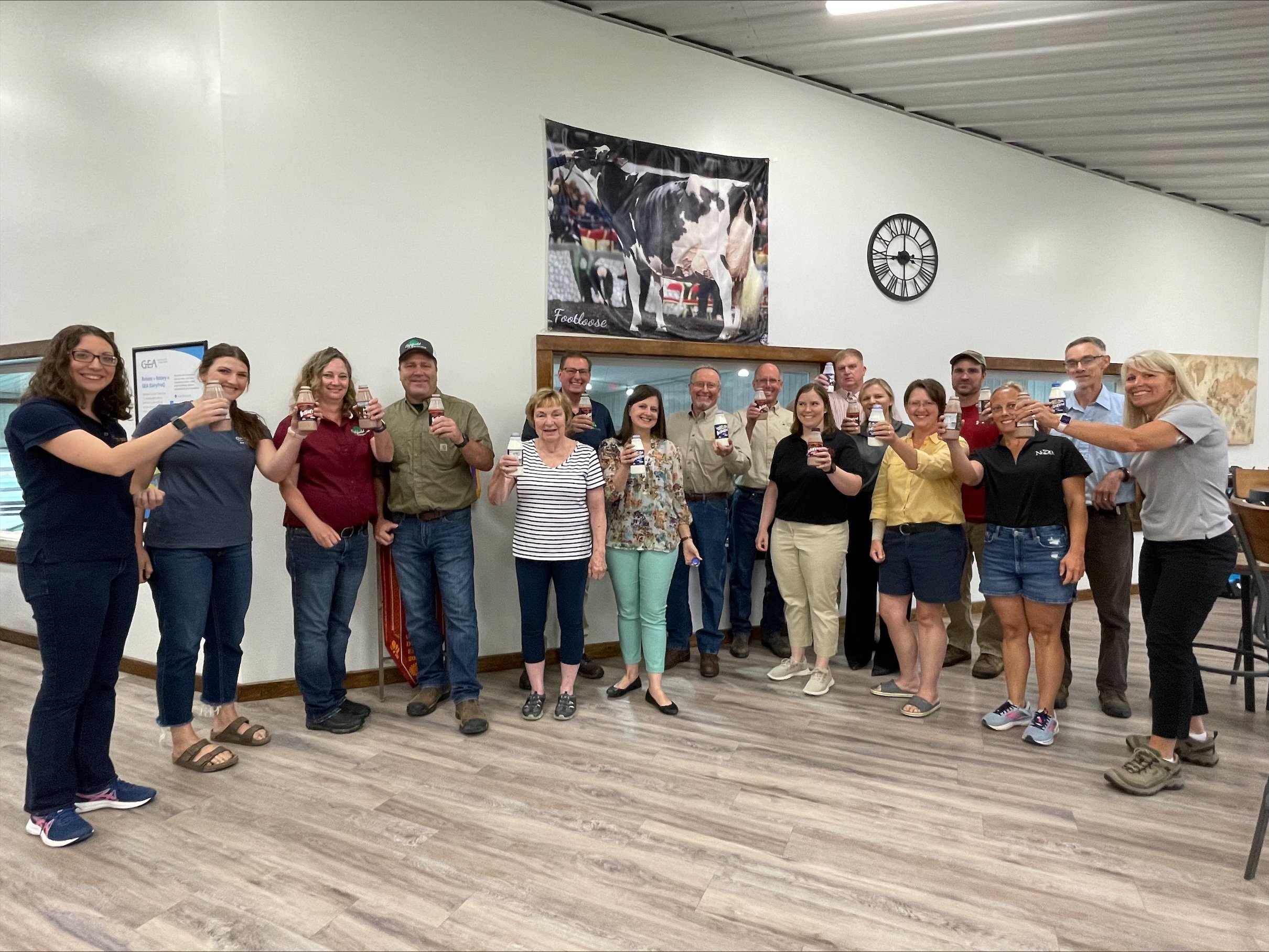
Attendees of the celebration at Lamb Farms joined together for a milk toast in honor of Dairy Month.

By Charlie Elrod, NEAFA Vice-President

Celebrating Dairy month in June is always a great time to appreciate the great industry that we are all fortunate to be a part of.  Once again this year, the leadership of Northeast Agribusiness and Feed Alliance, Northeast Dairy Producers Association, New York Farm Bureau, Upstate Niagara Cooperative and the New York State Department of Agriculture and Markets (NYSDAM) gathered at Lamb Farms in Oakfield Corners to share their thoughts on the state of New York’s dairy industry.  Commissioner Ball of NYSDAM kicked things off by relating how vital the dairy industry is to New York state.  He shared a story of Governor Hochul calling him in on the day after she was inaugurated and telling him that she would do whatever he needed to make sure the department and the industry had the full support of NYS government.  He saw this backed up by her active engagement in advocating for the Fairlife plant to be sited in NY.  I believe we’ve also witnessed this commitment to the dairy industry in the Governor’s budget and the additional funding supported by the NYS legislature.  

From the representatives from NEDPA we heard about the momentum and optimism within the dairy community.  We heard how the increasing capacity of processing plants around the state, plus the Fairlife plant, have made producers feel more confident in making investments in their facilities and new technologies to make them more efficient, productive, profitable and sustainable.  They are encouraged by the increasing number of FFA chapters across the state, which will help drive youth to consider careers in the dairy industry.  The strength of organizations like NEDPA and the active collaboration between the likes of NEAFA and NYFB strengthens their voice in government and in telling their story of animal welfare and sustainability to the wider public.

Technology was at the forefront of many comments, especially as we sat in the observation room above the Lamb’s 72-stall robotic carousel milking parlor, the first of its kind in the Northeast.  The Lambs and a few of their employees spoke about the continuing need for employee development to engage with higher and higher levels of automation, technology, genetics and other advances in dairy management.  The celebration was then wrapped up with snacking on some of the Lamb’s Mexican-style cheeses produced from their milk and a toast with milk provided by Upstate Niagara Cooperative.  This was a great opportunity for industry leaders to network and share their insight into what makes our industry hum.  A special thanks to the Lamb family for hosting and to Tonya Van Slyke, NEDPA’s Executive Director, for hosting and organizing this great event.

President's Pen: “Collaborate and Celebrate”

By Jenny Mills, NEAFA President

There are many reasons to celebrate June is Dairy Month!  I am excited to celebrate the producers and suppliers of those farms that work tirelessly to put food on our plates and take care of the land, animals and employees 24/7 even in some of the warmest June temperatures we have experienced recently.  In addition, I am celebrating the collaboration we have in agriculture.  There are several articles in this issue highlighting the legislative wrap-ups and June Dairy Month celebration that NEAFA participated in with the Northeast Dairy Producers Association, New York Farm Bureau, Upstate Niagara Cooperative at Oakfield Corners Dairy in Batavia.  Attendees included New York Agriculture Commissioner Ball, Deputy Commissioner Howard and Policy Advisor Giuliano.  Thank you to Dr. Charlie Elrod for representing NEAFA at this roundtable event, please check out Charlie’s article in this newsletter.

Collaboration with our legislative partners has been critical to getting our priorities and voices heard.  Thank you to our collaborators in Vermont – the Vermont Dairy Producers Alliance.  The neonic bill was one of the hot topics in Vermont, many thanks to all of you who reached out to state legislators.  The bill passed the legislature and was vetoed by Governor Scott, only to be overridden by the legislature in late June.  Thank you to Shouldice and Associates for their professional efforts.  Collaboration will continue with VDPA to increase our voice in Vermont.

In New York, a huge thank you to Hinman Straub and Associates for not just representing NEAFA’s interests in the halls of Albany, but also for working together with several other firms representing our collaborators to align on messaging and updates on many active bills in New York.  During our visits to key legislators in May, we shared NEAFA’s point of view on a couple of bills we were against.  Two of those bills did not pass both houses, including:

  • TEMP Act: This proposal would have established a protection policy for employees against high heat levels in certain workplaces. This bill did not get two house approval, though legislation that placed more proscriptive restrictions on heat conditions in schools did. 

  • Extended Producer Responsibility (EPR): This bill would assign responsibility for recycling and waste reduction to producers. 

Although these did not pass the legislature, we can expect them to return in the next session.

In addition to these two bills we opposed, several bills passed the legislature and will be on the Governor’s desk for signing.  Check out the NY legislative update article for more specifics.  Continuing our collaboration with industry partners around key policy issues, including transportation, will be critical in the months ahead. 

I hope to see you all this summer – mark your calendars for the NEAFA Golf for Good Works Tournament on August 19 (reception) and 20 (golf tournament).  We will again be at the gorgeous Turning Stone course in Verona, NY.   A great day for a great cause – helping our youth in agriculture!  

Raise a glass of milk and celebrate June Dairy Month!  We have accomplished several key initiatives and are working on continued collaboration.  Thank you for your input on key issues and continuing to supply and support our many producers throughout the Northeast!

NEAFA Member Profile - Kelly Elzy, Eastern Minerals

By Eric Jenks, Special to NEAFA

For May, NEAFA spoke with Kelly Elzy of Eastern Minerals, Inc.  Elzy is the Northeast Area Manager for the company. “Eastern Minerals, Inc. is one of four separate mineral companies across the United States that share a management team,” said Elzy. “We are a private label trace mineral premix manufacturer that opened in 1978 in Henderson, North Carolina, which is about thirty miles north of Raleigh, NC. We make trace mineral premixes, all proprietary for the agricultural industry, in addition to distributing other minerals and feed ingredients. Dietary trace minerals are essential to all animals and people, and we manufacture specific premixes for dairy, poultry, swine, beef, and pets. Eastern Minerals primarily serves the Eastern Seaboard; Maine through South Carolina.”

Elzy joined the company twelve years ago. “I’m from Illinois originally, and have a Bachelors and Masters in Animal Science and Nutrition from the University of Illinois. I was a city kid, not from a farm. Animal Science 100 got me into agriculture freshman year. I went to the livestock pavilion and was hooked. The people that I work with and call on are my favorite part of the job. I’m blessed to be in a sector of business that has good people to work with.”

As Eastern Minerals’ customer base grew north from North Carolina, they found it beneficial to join NEAFA. “We’ve been a member for years,” said Elzy. “NEAFA is a great organization that does a lot for Northeast farmers, in addition to providing educational and networking opportunities across the feed industry. New York has a lot of legislation surrounding agriculture, and we’re blessed to have an organization like NEAFA to speak up for us. For about 10 years, I’ve served on the events committee for the NEAFA Annual Meeting and yearly Golf for Good Works Tournament. I like how these events can help to provide an informal setting where young people can meet and visit with NEAFA members. One thing that I love about agriculture is that the people in this industry are warm, friendly, and inviting.”

Looking to the future, Elzy sees a push for more locally grown goods. “I do think that people are coming back to supporting local agriculture,” said Elzy. “There’s a new desire to have an understanding of where their food comes from. I think the pandemic really pushed consumers towards that, because the most important thing back then was going to the store and having access to meat, milk, and eggs to buy. A lot of people realized that they didn’t know where it was coming from. Today locally raised is more accessible, and people value that supporting their local farmers is not only supporting a business, but a family in their community. I have a lot of hope for the next generation that is moving into agriculture today.”

For more information on Eastern Minerals, Inc. and their sister companies across the country, visit www.seminerals.com

Agri-Services Agency Highlights Loss Prevention 

Agri-Services Agency (ASA) has a long history serving the agriculture community. As an insurance agency founded by farmers over 50 years ago, ASA exclusively serves the agriculture community with the goal to help farmers, ranchers and agri-business owners access comprehensive insurance coverage at an affordable price. 

Offering a superior workers’ compensation program is a tool to help operations minimize risk and keep employees safe. “Our goal is to identify potential risks and help prevent accidents or losses within a business. Whether that is a large catastrophe or multiple, small frequency claims,” said Ashley Nadeau, Senior Loss Control Analyst for ASA. “While a lot of people might think the focus is on catastrophes, small frequency claims can be a big issue. They affect your company or farm in bigger ways, not just with higher premiums. If employees are regularly getting injured, you’ll have morale issues and potentially spend additional time and money on training a replacement,” she continued. “It’s important to understand that even if you haven’t had a large claim before, smaller ones can lead to something bigger if you don’t figure out the root cause.”

Based out of Syracuse, N.Y., Nadeau covers the Northeast region. “I put in a lot of time on the road, traveling out to farms or agricultural facilities. While I’m there, I recap their loss history for the last five years, discuss training needs and complete on-site inspections. I am looking for any  hazard that could cause a potential injury, it may even be one they might walk past every day without even realizing it’s there. This practice is one of the ways I bring value to the individuals I work with.” 

Sometimes, it can be difficult to connect with businesses about loss prevention and safety. “Business owners and operators can be wary of safety trainers or consultants,” said Nadeau. “Owners are worried they may have to drastically change their business, are concerned about premium increases,  or just hesitant to let an outside party walk through their farm. Change can be scary, but my goal is to make it as easy as possible for the business owner. I look for improvements that will help grow a business, and, long-term, potentially lead to lower premiums. This will all come from fewer claims and a safer environment,” she stated. But, according to Nadeau, “business owners must be open to loss prevention in order to make positive changes. That is what I love about the clients here at ASA. I work with farmers that are down-to-earth people. They value their employees and want to create a successful operation. I have less challenges with them because of that. They are used to having all sorts of inspections from OSHA to food safety, so when there’s a positive change they can make, they’re open to it.”

For businesses looking to reduce claims, training is key. “The type and amount of training needed depends on the business,” said Nadeau. “Getting all the employees together at the same time can be challenging — trucking for example, people are always on the road. There are different approaches to training – sometimes, shorter, more frequent talks once a week work well. Other times, making time monthly, quarterly, annually or before the start of a busy season can be helpful. If you’re working with seasonal workers, like the fruit industry for example, it’s good to have an initial training when they start, and then do corrective training if needed. The most important thing is to make training schedules that best fit your company structure and then stick to that schedule.” If a business is struggling with keeping up with trainings, ASA can assist with that as well. 

Training is necessary for a lot of reasons. “Take a tractor for example,” said Nadeau. “Tractors are a huge investment. The equipment is expensive and can be dangerous if used incorrectly. You want to protect the employee operating the machine, the equipment, and your property.” Ashley goes on to mention during training “whether it is a new topic every year or refresher content, at almost every training, there is someone that learns something new – even if they have been there for years and operated the same tractor for decades or are a new employee. It can be easy to forget, and it’s always good to have a reminder.”

Consultations with ASA Loss Control Consultants can lead to positive outcomes. “I’ve had a lot of businesses that I’ve helped and built relationships with, and I think that’s my biggest success since joining ASA,” said Nadeau. “They’ll call me and ask for advice whether I’m their agent or not. They’ll ask me about other things aside from loss control. It’s a privilege that they feel comfortable enough to call me to ask for help and advice whether or not it’s related to safety. I’m glad to make a difference in what they do.”

When dealing with a loss, it’s important to act quickly to gather the facts behind it. “When there is a loss, it’s really important to get as much information as you can,” said Nadeau. “Farmers and business owners should find out if there were any witnesses and talk to anyone that was involved in the accident. You want to report the claim as quick as possible, and document it well.” She explains, “reporting within 3-5 days can reduce the cost of the claim, and hopefully get the employee back to work quicker. Afterwards, it’s also integral to do a root cause analysis. It’s important to figure out why the accident happened and how to prevent it in the future. You also need to share out information with other employees who do the same tasks and retrain them.” 

When looking at preventing losses, hiring the right employee can also help. “I always suggest to look for integrity when hiring,” said Nadeau. “Poor integrity can cause a whole slew of things to go wrong. If an employee is being unsafe, don’t keep them because you’ll be short-handed. There are just too many long-term ramifications from keeping an unsafe employee.” 

For Nadeau, ASA has been a great fit. “I love ASA,” said Nadeau. “I couldn’t ask for a better team to work with; everyone is involved and ready to jump in and help. When coming to the team, the first thing I noticed is how nice and welcoming everyone was – it is enjoyable to go to work when you work with good people.”

As agricultural insurance experts, ASA offers comprehensive insurance programs design for farmers, ranchers and agri-businesses. We are your advocates — working to find the best insurance solution to help you minimize risk, protect your operation and secure competitive benefits for you and your employees. For more information, contact Agri-Services Agency at 1-877-466-9089 or visit agri-servicesagency.com/.

Grow NY Farms Update

Dear Friends of New York State Family Farms,

Thank you to everyone who has donated or continues to give to this important campaign to ensure the rights of farmers and farmworkers alike.

Grow NY Farms has achieved real success. Partners across agriculture have supported a lawsuit that seeks fairness for all. The temporary restraining order we sought this winter in Western New York Federal Court was successful in securing the rights of farmers to be able to legally talk to their employees about collective bargaining. This also resulted in a change at the Public Employment Relations Board in the information they are seeking from labor unions. These victories for fairness matter!

But it isn’t over yet. We have appealed the other decisions that did not go our way. This includes securing additional rights for farmworkers and farmers. Under current law, farmworkers are being denied the collective bargaining rights that all other workers have in New York State. By taking action in court, New York’s agriculture industry aims to improve protections for farmworkers' rights by amending the FLFLPA to guarantee and protect the free speech and due process rights of farmworkers.

We strongly believe that certifying H2A employees as eligible participants in a collective bargaining agreement violates the federally mandated H2A guest worker agreements. Also, once guestworkers return to their home countries, they are no longer employees of the farm.

The additional legal arguments listed in the court documents impact all family farms with employees.

  • Violations of due process by PERB, including arbitrary interpretations and not allowing all the facts to be heard.

  • NO decertification process nor a right for farmworkers to vote on unionization.

  • PERB exceeding the authority granted to it by law.

We are hearing farmworkers are interested in joining with us, which will make a big difference. If you know additional farmworkers who may want to be a part of the lawsuit, let us know.

Also, we are asking for additional financial support for the appeal. It will be filed on May 30. New York State has until August 5 to respond. We knew this would be a long process, and a costly one. But we are making a difference. Please support the effort if you can.

Consider donating to help in this pressing effort. The outcome will help determine the future of family farming in New York State.

In addition, please share this letter with other farms, retired farmers, agribusinesses, and supporters of having a strong food system in this state. We need all the help we can get.

Checks made out to “Grow NY Farms” can be sent to 8351 Lewiston Rd #3-304, Batavia, NY 14020. You may email questions to grownewyorkfarms@gmail.com.

-------------------------------------------(Please include with donation)------------------------------------------------------

Name: 
Address:
City, State, Zip Code:
Phone Number & Email:

Would you be willing to serve as a media spokesperson: YES  or  NO

Suggestions or Referrals to Reach Out to:

You can also find a pdf of this letter by clicking here.

The 2024 VT Legislative Adjournment

Cheri L. L'Esperance
William Shouldice & Associates LLC
802.839.0006

As the 2024 Legislative session winds down, many are looking forward to a break.  Both Chambers had multiple bill presentations and floor debates causing things to drag on late into the final evening. 

The break won't be long as everyone is expected to be called back for a veto session on June 17th. On the list of bills that Governor Scott may veto are data privacy, education/property tax rates (Yield bill), housing/Act 250 bill, and drug (safe) injection sites officially termed “Overdose Prevention Sites”.  We also expect the Governor to give several health care and environmental bills a deep review.

The past two weeks of the session have been like no other. With a self-imposed pressure to adjourn this week, disagreements over legislation have become very heated and contentious. It has been interesting watching the Senate do their best to wind down the session, but the "rookie" Senators have grappled with understanding legislative process and decorum. The continual stepping outside the chamber during floor times in an attempt to attach last minute amendments onto bills, made the Democratic "senior" Senators uncharacteristically aligned at times with Republicans in order to vote them down and move the process forward in a speedier fashion. This in itself added hours to the floor debates.

It is likely that when the General Assembly gathers in June legislators will be more rested in the midst of focusing on campaigns, and will hopefully be more united than they have been during these last few weeks of utter chaos that has been displayed. 

 __________________________________________________________________

VDPA Session Wrap Up:

VDPA members did a great job educating their legislators and members of the public on several bills. Members contacting their legislators and discussing issues in the dairy industry and agriculture sector is helpful, and we would like to continue building on this next year. More importantly, we worked with the Senate Agriculture committee to send a letter to the federal delegation to support passage of “The Whole Milk for Healthy Kids Act.” This federal bill ensures that students receive many health benefits and nutrients milk provides in their school lunches and demonstrated the importance of dairy in the balanced meal. VDPA also met with AAFM quarterly to receive updates and talk about issues of concern. The lines of communication have been very open and helpful this session. Working with the Agency has been helpful legislatively. 

Although it was a difficult year legislatively, we should thank Senator Bobby Starr for his constant dedication to the Agriculture Sector in Vermont. Sen. Starr was always open to hearing from our dairy farmers and we appreciate his four decades of service. If you cross paths with Senator Starr, please thank him for his help to the agriculture industry of Vermont.

The action on legislation is outlined below. It will be several weeks before we know what bills Governor Scott will approve. For those that are not approved/vetoed, the General Assembly will need to decide if they have a 2/3 majority in favor of overriding the veto. The veto session is scheduled for June 17th.  

H 626 - An Act Relating To Animal Welfare

NEW STATUS: Senate proposal of amendment concurred in

This bill is adding a surcharge on the rabies licenses for dogs which will go towards setting up a Division of Animal Welfare under the Department of Public Safety. The hope is this surcharge generates enough money to fund one position to run the Division of Animal Welfare and the division will continue to grow. This would be out on its own, because the Agency of Agriculture and the Division of Fish & Wildlife do not feel they can manage this sector themselves.

We were able to advocate for this bill to slowly set up this division instead of an expansive and overreaching arm of the Department of Public Safety. The original bill had a tax on commercial feed which we were able to get removed, this was replaced with a $2.00 increase to the rabies license for household pets.

H 687 - An Act Relating To Community Resilience And Biodiversity Protection Through Land Use

NEW STATUS: Senate proposal of amendment to House proposal of amendment to Senate proposal of amendment concurred in

The bill would make changes to land use regulations, municipal zoning laws, Act 250, and laws pertaining to the construction and maintenance of the housing supply in Vermont. The bill would also restructure the administration of Act 250 with a professionalized Land Use Review Board (LURB) replacing the current Natural Resources Board (NRB) on July 1, 2025. The bill would also make appropriations and establish programs and special funds to support housing development and revitalization efforts, funded by an increase to the property transfer tax (PTT) on second homes.

The fiscal impacts of the bill are:

  • An increase in the Property Transfer Tax (PTT) rate on year-round habitable secondary residences without a landlord certificate from 1.25% to 3.4%. Exemption thresholds for the general 1.25% rate of the PTT and Clean Water Surcharge (CWS) would also increase. These combined changes would generate $15.7 million in additional revenue in the fiscal year 2025.

  • The bill would allocate $8.3 million of the additional revenue generated by PTT changes to the General Fund for various appropriations:

    • The Vermont Housing and Conservation Trust Fund (VHCTF) would receive a $6.1 million General Fund appropriation.

    • The Municipal and Regional Planning Fund (MRPF) would receive a $1.28 million General Fund appropriation.

  • An increase in Clean Water Surcharge (CWS) exemption values in the PTT from $100,000 to $200,000 for principal residences and from $200,000 to $250,000 for principal residences financed through the Vermont Housing and Conservation Board (VHCB), the Vermont Housing Finance Agency (VHFA), or U.S. Department of Agriculture Rural Development (USDA-RD) housing programs. The CWS increases from 0.2% to 0.22%.

  • This would generate an additional $60,000 in annual revenue for the Clean Water Fund.

  • A property tax freeze for property rehabilitation or new construction in certain designated areas impacted by flooding in 2023.

  • This is expected to lead to $1.16 million in forgone Education Fund revenue in fiscal year 2026, $2.44 million in foregone revenue in fiscal year 2027, and $3.90 million in foregone revenue in fiscal years 2028.

Act 250 Revision:

Board Composition: Changes include the restructuring of the Natural Resources Board, with new appointment procedures and term lengths for members and alternates.
Duties and Powers: It outlines the duties, powers, and processes for removal of board members, as well as the creation of a Nominating Committee.
Public Involvement: The document emphasizes transparency and public involvement in the appointment process and decision-making.

This change to Act 250 is the foundation for the bill in order to encourage additional housing in Vermont.

Act 250-Tiered Approach:

  • Tier 1A and B: Downtowns and villages with growth capacity would receive full or partial exemptions from Act 250 review until January 1, 2027.

    • Would exempt all construction housing within downtowns with permanent zoning and subdivision bylaws, and sewer, water, or appropriate soil. It would also exempt the construction of 75 units within a half-mile of a designated downtown development district, or within new town centers, growth centers, or neighborhood development areas.

    • Interim exemptions would also include housing projects of 50 units or less on ten acres of land within a quarter mile of village centers with permanent zoning or subdivision bylaws, and sewer, water, or appropriate soil. Areas within a quarter mile of a transit route in an urbanized area of greater than 50,000 would also be exempt.

    • Would not require Act 250 permitting for the construction of improvements for a hotel or motel converted to permanently affordable housing.

    • Exempt the construction of improvements for an accessory dwelling unit until July 1, 2028.

  • Tier 2: Areas falling between these categories would largely maintain the status quo under the law.

  • Tier 3: Ecologically important natural resource areas would automatically trigger Act 250 consideration.

The adoption of Tier 1A and Tier 1B areas could create further expansions of areas exempt from Act 250. Municipalities could apply for Tier 1A status starting January 1, 2026, if they meet certain criteria related to flood risk, capital budget, and municipal staffing to support development, zoning and by-law requirements, wastewater infrastructure, and historic and environmental planning. Residential developments in these areas would be exempt from Act 250 and associated permitting fees.

  • Tier 1B areas would be noted on regional plans developed by RPCs and approved by the LURB if they meet certain requirements related to permanent zoning and bylaws, flood risk, water supply and wastewater infrastructure, and municipal staff available to support the development. Residential or mixed-use developments in these areas would be exempt from Act 250 and related permitting fees if they have fewer than 50 housing units on ten acres or less of land.

The exemptions contained in this section would reduce Act 250 permitting fees that flow to the Act 250 Permit Fund, which funds NRB and ANR activities related to the Act 250 process. Fees for the NRB are $6.65 per $1,000 of the first $15,000,000 of construction costs. Fees decrease to $3.12 per $1,000 of additional construction costs, up to a maximum of $165,000 per permit. Projects may also be subject to subdivision.

Promoting Housing Development: The proposal calls for exempting areas with strong local zoning regulations from Act 250 review. This move encourages denser housing development in existing downtowns and villages.

Enhanced Protection: The study also recommends strengthening Act 250 to better safeguard highly sensitive natural resource areas.

Other provisions:

  • Create three Act 250 fees to all persons filing an appeal, cross appeal, or petition from a District Commission decision or jurisdictional opinion. This fee would be $295 unless the LURB approves a waiver based on indigency. Appeals are currently heard through the Judiciary’s Environmental Division. Initial appeal filings currently incur a $295 fee, subsequent pleadings a $120 fee, and post judgment motions a $90 fee, all of which flow to the General Fund. Currently, the number of filings per year is limited, leading to a negligible General Fund impact starting in fiscal year 2027 with the transfer of the appeal process to the LURB. The second fee would be $295 for any municipality filing an application for Tier 1A status. The third would be $295 and apply to any regional planning commission (RPC) filing a regional plan or future land use map that is reviewed by the LURB. Revenue would depend both on the number of towns that file applications and how RPCs file plans and maps. If all 247 municipalities and 11 RPCs were to submit plans, the two fees could generate approximately $76,000 for the Act 250 Permit Fund. However, it is unclear how many towns will apply for Tier 1A status and when they will apply. Therefore, revenue is likely to be far less than $76,000. RPCs would also have to pay the $295 fee when they resubmit regional plans or land use maps every eight years, generating nominal additional revenue.

  • Modifies the definition of accessory on-farm businesses and exempts improvements to those businesses from Act 250 permitting. Due to the limited number of current permits issued to on-farm businesses.
    accessory businesses, this change is estimated to have a negligible impact to Act 250 Permit Fund revenues.

  • Would create an Act 250 jurisdictional trigger for the creation or improvement of a new single road of greater than 800 feet or of roads and any associated driveways greater than 2,000 feet, after July 1, 2026.

  • Extend the Act 250 exemption created by Act 47 of 2023 for priority housing projects within a designated center through July 1, 2027, which is one additional year compared to current law. It would also add an exemption to developments within a half-mile of the designated center located within the same municipality. The exemptions would only apply if a development received a jurisdictional opinion and substantially completes construction by June 30, 2029

Oppose - H 706 - An Act Relating To Banning The Use Of Neonicotinoid Pesticides

House message: House concurred in Senate proposal of amendment (05/03/24)

This bill prohibits the sale, offer for sale, distribution, or use of neonicotinoid treated article seeds for soybeans or cereal grains crops. It prohibits outdoor application of neonicotinoid pesticides during bloom and on certain crops, including soybeans, cereal grains, and specific vegetable crops.

It does allow for the Agency of Agriculture Food, & Markets (AAFM) to give exemptions for reasons such as “environmental” and “agricultural emergencies”.

Importantly, there is a contingency in the bill that ties this law to New York State. If New York does away with or delays their law banning treated seeds, Vermont will follow, without having to come back to the legislature. It is important to note that New York also has an exemption process, and only bans the sale of these seeds, not the use like Vermont’s law. This bill goes into effect in 2029.

This bill as introduced was a much more aggressive ban, VDPA members came out in droves to testify and educate legislators on the detrimental effects of this bill. Amending the language by pushing out the effective date and having the language mirror New York’s is a win because we can work with our neighboring state to buy seeds. Spreading the work about this bill and educating members of the public was also helpful, we did this by getting members to do interviews, call their legislators, and talk to radio stations and newspapers was helpful to our cause.

H 877 - An Act Relating To Miscellaneous Agricultural Subjects

NEW STATUS: Senate proposal of amendment concurred in

The annual House Miscellaneous Agriculture bill is largely technical but does include changes to pesticide training and certification program. The Agency wants to contract with a third-party vendor to administer pesticide examinations through a remote program. The Agency may also charge an additional fee to applicants who prefer to utilize the electronic or alternate testing service for pesticide certification or licensing examinations. AAFM will continue to administer in person examinations that do not include an additional fee. Finally, the language makes changes to indirect discharges into Class A waters and regulations concerning hemp and cannabis.

H 887 - An Act Relating To Homestead Property Tax Yields, Nonhomestead Rates, And Policy Changes To Education Finance And Taxation

NEW STATUS: House proposal of amendment to Senate proposal of amendment concurred in

The bill changes to property tax yields and rates, which were projected to increase 15-18%, for the homestead and nonhomestead property tax bills. As passed by both Chambers, the bill establishes an average statewide property tax increase of 13.8%. The lower rate of increase is in part due to a $25 million buy-down.

Summary:

  • Revenue Increases: It seeks to generate additional revenue by repealing the sales tax exemption for remotely accessed prewritten software and imposing a 3% surcharge on short-term rentals.

  • Committees and Commissions: Establishes various groups to study and recommend improvements to Vermont’s public education system, including the "Commission on the Future of Public Education in Vermont."

  • Fiscal Impact: The Joint Fiscal Office cannot estimate the overall impact on the Education Fund but provides projections for specific sections of the bill.

  • Commission Creation: Establishes the Commission on the Future of Public Education in Vermont, focusing on a vision for a sustainable and equitable education system.

  • Commission Composition: Details the diverse membership of the Commission, including representatives from various educational and governmental bodies.

  • Duties and Reports: Outlines the Commission’s responsibilities, including public engagement, policy considerations, and the submission of reports and proposed legislation.

  • Support and Meetings: Specifies the support and assistance provided to the Commission, including the scheduling of meetings and the provision of necessary data.

  • Education Spending: Adds an exclusion for certain voter-approved bond payments from “education spending” calculations.

  • Transportation Reimbursement: Details a 50% reimbursement grant for allowable transportation expenditures, with specific conditions and limitations.

  • Tax Credit Claims: Recommendations for property tax credit claims improvements, including asset declaration, are to be submitted by December 15, 2024.

H.887 also establishes a committee to study options for a long-term solution to Vermont’s K-12 funding.

This bill is on Governor Scott’s list to review closely and potentially veto. If a veto occurs the Legislature can try to override the Governor in June or amend the bill through negotiations.

S 25 - An Act Relating To Regulating Cosmetic And Menstrual Products Containing Certain Chemicals And Chemical Classes And Textiles And Athletic Turf Fields Containing Perfluoroalkyl And Polyfluoroalkyl Substances

NEW STATUS: Passed by Senate and House

The bill contains measures affecting agriculture and will require cooperation between the Agency of Agriculture, Food and Markets, the Department of Health and the Office of the Attorney General. Both Agencies will set up a working group that will propose a program requiring the State to identify and restrict the sale and distribution of consumer products containing perfluoroalkyl and polyfluoroalkyl substances (PFAS) that could impact public health and the environment.

The program will:

(1) identify categories of consumer products that could have an impact on public health and environmental contamination.

(2) propose a process by which manufacturers determine whether a consumer product contains PFAS and how that information is communicated to the State.

(3) address how information about the presence or lack of PFAS in a consumer product is conveyed to the public.

(4) describe which agency or department is responsible for administration of the proposed program.

(5) determine whether and how other states have structured and implemented similar programs and identify the best practices used in these efforts.

(6) propose definitions of “intentionally added,” “consumer product,” and “perfluoroalkyl and polyfluoroalkyl substances” (“consumer products” includes restricted and nonrestricted use pesticides.).

(7) provide recommendations for the regulation of PFAS within consumer products that use recycled materials, including food packaging, cosmetic product packaging, and textiles.

The report and recommendation shall be submitted to the Committees of Jurisdiction by November 1, 2024.

The language pertaining to agriculture came from S. 197, where it was a ban on the pesticide containers with PFAS in them, however we were able to advocate for a study on this topic because the EPA is working on finding a replacement container for these products but there is currently no alternative.

Monitor - S 102 - An Act Relating To Expanding Employment Protections And Collective Bargaining Rights

NEW STATUS: Passed in concurrence

The bill establishes a good cause standard for termination of employment, require employers to provide severance pay to terminated employees, and permit employees or representative organizations to bring an enforcement action on behalf of the State for violations of the good cause termination requirement. It would prohibit employers from taking adverse employment actions against an employee related to their exercise of free speech rights.

Current law allowed for an exemption for agricultural workers to collectively bargain. In the Senate, the agriculture workers exemption was removed. VDPA member, Richard Nelson, testified on this bill to the House committee on General & Housing. After much outreach and discussion, the exemption was restored in the House and a study to further consider. The bill creates the Agricultural Worker Labor and Employment Laws Study. The study will examine the application of Vermont’s labor relations and employment laws to agricultural workers and identify potential legislative actions to provide additional coverage to agricultural workers under those laws. The composition of the committee is eight members, four from the House and four from the Senate, ensuring representation from different political parties and relevant committees.

Power & Duties:

  1. Identify existing employment rights for agricultural workers under Vermont and federal law.

  2. Identify Vermont and federal employment and collective bargaining laws that do not apply to some or all Vermont agricultural workers.

  3. Examine and compare the structure of collective bargaining rights for agricultural workers in other states with similar agricultural economies, including coverage, certification of exclusive bargaining representatives, subjects for bargaining, procedures for resolving bargaining impasse, unfair labor practices, and costs related to organizing and contract negotiation for both employers and labor organizations.

  4. Examine the structure of Vermont’s existing labor relations laws and the capacity of the Vermont Labor Relations Board to administer collective bargaining in Vermont’s agricultural sector.

  5. Develop a framework for agricultural collective bargaining in Vermont and identify other potential changes to Vermont’s employment laws to provide additional rights and protections to agricultural workers.

The written report is due to the General Assembly by December 15, 2024, containing findings and recommendations for legislative action. The report should include a proposal for permitting agricultural workers to collectively bargain, addressing various aspects such as coverage, bargaining unit size, seasonal workers, bargaining procedures, and the role of the Vermont Labor Relations Board.

VDPA member, Richard Nelson, testified in the House Committee on General & Housing, his testimony made a big difference and allowed the exemption to remain in law and they will now study the topic and we can review next year with the legislature.

S 213 - An Act Relating To The Regulation Of Wetlands, River Corridor Development, And Dam Safety

NEW STATUS: Passed in concurrence

There was a near double digit bill introduction this session regarding wetlands, river corridor or dam safety, after the floods this summer. This bill, the only one of these to make it through the finish line, would establish a new state permitting system for building in river corridors, sets new standards for wetland protection and increases dam safety measures. Some say it is important to protect buildings from events like the floods this summer.

This bill amends statutory provisions related to wetlands, river corridor development, and dam safety. Most notably, the bill requires the Agency of Natural Resources (ANR) to update the Vermont Significant Wetlands Inventory (VSWI) maps no less than annually and complete High Quality Wetland Inventory mapping for all tactical basins in the state every five years. It would update the Vermont Wetlands Rules and require an annual report on losses and gains of significant wetlands in the state.

In addition, it amends the statewide River Corridor Base Map to identify areas where infill and redevelopment wouldn’t increase fluvial erosion hazards. It would redesignate the Vermont Unsafe Dam Revolving Loan Fund as the Vermont Dam Safety Revolving Loan Fund. Proposed changes would make funds available for both emergency and nonemergency projects. 

S 301 - An Act Relating To Miscellaneous Agricultural Subjects

NEW STATUS: Senate proposal of amendment to the House proposal of amendment concurred in

The Annual Senate Miscellaneous Agricultural bill was largely technical in nature.

Agricultural Water Quality

  • Amends Vermont seeding and filter strip program, allowing the Secretary of Agriculture to develop a program compensating farmers for establishing and maintaining grassed waterways and filter strips on cropland.

Agricultural Warehouses

  • Amends licensing requirements for public warehouses storing farm products, including dairy, eggs, meat, poultry, and produce, and sets licensing fees.

Milk Handling

  • Amends definitions and licensing requirements for milk handlers, establishing fees based on the volume of milk or dairy products handled annually.

Public Warehouse Licensing

  • Establishes licensing requirements for various entities involved in meat, meat food products, or poultry products, including commercial processors and distributors.

Livestock Dealers

  • Amends definitions related to livestock dealing, clarifying exemptions and licensing requirements for livestock dealers, packers, and transporters.

Pesticides; Mosquito Control; Rodenticides

  • Amends rules related to mosquito control, grants, and pesticide use, including restrictions and approvals for rodenticides and larvicides.

  • It mandates the Secretary to register second-generation anticoagulant rodenticides as restricted use pesticides if they are distributed or sold within the state.

Vermont Agricultural Credit Program

  • Amends the creation and definitions of the Vermont Agricultural Credit Program, providing alternative credit sources for farmers and forest product businesses.

Loan Eligibility Standards

  • Amends loan eligibility standards for farmers, forest product businesses, and other entities, outlining residency and ownership requirements.

The Senate had a last-minute amendment to ban the sale of bear parts and the bill will head to the Governor’s desk.

The following bills did not pass the House & Senate in concurrence

H 81 - An Act Relating To Fair Repair Of Agricultural Equipment

NEW STATUS: Notice Calendar: Senate Proposal of Amendment (05/10/24)

The bill as passed by the Senate states that if an original equipment manufacturer has entered into an MOU, then they are not subject to the bill. However, if that MOU is canceled for any reason, they must comply. The latest language also took out the language related to costs and limitations and that it has be a fair and reasonable price.

This bill was sent back to the House, where the two committees of jurisdiction did not like the Senate changes. There was not enough time for the House to make changes and send it back for the Senate to concur. Therefore, the bill did not make it to the finish line. The bill is considered dead; however, the committees could work on this bill during the veto session. The current language is a compromise and far better than the bill as introduced. VDPA members testify and work with legislators to get this language in a workable place for relevant stakeholders.

S 258 - An Act Relating To The Management Of Fish And Wildlife

Read first time and referred to the Committee on Environment and Energy (03/28/24)

The bill passed by the Senate redefines the composition and functions of the Fish and Wildlife Board, emphasizing conservation, public input, and scientific management in regulating fish and wildlife. It also addresses the hunting of coyotes with dogs, introducing permits and regulations.

This bill was highly contentious this year but died in the House committee on Environment & Energy after the Senate amended it. This bill could come back up during the veto session.

S 197 - An Act Relating To Restricting Perfluoroalkyl And Polyfluoroalkyl Substances In Consumer Products

Read first time and referred to the Committee on Human Services (03/20/24)

The bill was turned into a study and that language was added into S.25.

S 272 - An Act Relating To The Regulation Of Second-generation Anticoagulant Rodenticides

Read 1st time & referred to Committee on Agriculture (01/17/24)

This bill was turned into a study and language was added into S.301. This bill was born out of one-person misusing rodenticide; we advocated for less strict regulation than was originally drafted. Please review S.301 for a detailed breakdown.

S 286 - An Act Relating To The Regulation Of Accessory On-farm Businesses

Read 1st time & referred to Committee on Natural Resources and Energy (01/17/24)

This bill stalled in the Senate Natural Resources & Energy Committee. An expansion of the current law was included in H.687.

S 292 - An Act Relating To Animal Welfare

Read 1st time & referred to Committee on Government Operations (01/17/24)

House version, H.626 passed both House & Senate.

S 311 - An Act Relating To Bringing Everyone Home

Committed to Committee on Natural Resources and Energy with report of Committee on Economic Development, Housing and General Affairs intact, under suspension of Senate Rule 49, on motion of Senator Baruth Committee Bill for Second Reading (02/20/24)

Some Language added into H.687, An act relating to Community Resilience And Biodiversity Protection Through Land Use.

H 128 - An Act Relating To Removing Regulatory Barriers For Working Lands Businesses

Rep. Durfee of Shaftsbury moved to commit the resolution to the Committee on Environment and Energy, which was agreed to Rep. Durfee of Shaftsbury moved to commit resolution to the Committee on Environment and Energy, which was agreed to Action Calendar: Favorable with Amendment (02/29/24)

H 420 - An Act Relating To Establishing A Program To Encourage The Implementation Of Year-round Agricultural Practices

Read first time and referred to the Committee on Agriculture, Food Resiliency, and Forestry (02/28/23)

H 586 - An Act Relating To Flood Protection And Climate Resilience Infrastructure And Financing

Rep. Sheldon of Middlebury moved that the Committee on Environment and Energy be relieved of the bill and that the same be committed to the Committee on Ways and Means, which was agreed to (01/24/24)

H 674 - An Act Relating To Regulation Of Septage And Other Materials Containing Perfluoroalkyl And Polyfluoroalkyl Substances

Read first time and referred to the Committee on Environment and Energy (01/05/24)

H 715 - An Act Relating To Climate Change Resilience Under Act 250

Read first time and referred to the Committee on Environment and Energy (01/10/24)

H 760 - An Act Relating To Act 250 Transparency

Read first time and referred to the Committee on Environment and Energy (01/11/24)

H 771 - An Act Relating To Landowner Liability For Unmarked And Improperly Marked Access Control Devices

Read first time and referred to the Committee on Judiciary (01/12/24)

H 810 - An Act Relating To Establishing The Agricultural Workforce And Housing Directory

Read first time and referred to the Committee on Agriculture, Food Resiliency, and Forestry (01/16/24)

H 811 - An Act Relating To The Eligibility Of Posted Land For Enrollment In The Use Value Appraisal Program

Read first time and referred to the Committee on Environment and Energy (01/16/24)

H 844 - An Act Relating To Appeal Rights For Extraterritorial Users Of Municipal Water And Sewer Systems

Read first time and referred to the Committee on Government Operations and Military Affairs (02/01/24)

S 228 - An Act Relating To Requiring A Jurisdictional Opinion To Be Exempt From Act 250

Read 1st time & referred to Committee on Natural Resources and Energy (01/09/24)

S 306 - An Act Relating To Changes To The Clean Heat Standard

Committed to Committee on Natural Resources and Energy on motion of Senator Bray Committee bill read first time & placed on Notice Calendar per Senate Rule 48 (01/31/24)
S 308 - An Act Relating To Updates To Land Use Planning

Committed to Committee on Natural Resources and Energy on motion of Senator Bray Committee bill read first time & placed on Notice Calendar per Senate Rule 48 (01/31/24)

Spring NEAFA Lobby Day Recap

Jenny Mills, NEAFA President

Charlie Elrod, NEAFA Vice-president

May 13th saw us heading back to Albany for a “mini-lobby day” which was targeted to discussing with legislators two bills we were advocating for and three which we were advocating against, as well as thanking the legislators for their very ag-positive New York State budget.  As has become the norm, Julie Marlette and Jim Carr from Hinman-Straub did a great job setting up appointments with our Senate and Assemblymembers as well as key ag legislators and members of the Senate Counsel’s office.  In all, we had eight appointments across the day.

The two bills we were expressing our support for grew out of the transportation summits we have organized with NEDPA and NY Farm Bureau over the last couple of years.   The first was a bill introduced by Senator Skoufis and Assemblymember Lupardo which would establish a program whereby farm trucks would be limited to no more than one DOT safety stop per day.  We feel this is a valid concern given that trucks hauling perishable products or livestock should not be subjected to multiple stops for safety inspections which will delay their timely delivery or induce unnecessary stress on animals.  In general, we received positive feedback on this bill in our meetings.  The second bill, sponsored by the same legislators would provide an exemption to the F and G endorsements on a CDL driver’s license for farm employees operating covered farm trucks within 150 miles of the farm. Given the nationwide shortage of CDL drivers, this bill could be helpful in allowing farms to get crops harvested and transported with available labor.  In a couple of discussions we did get some pushback on this bill.  Concerns raised included relatively inexperienced drivers driving through small rural villages in tractor trailer trucks, or whether 150 miles was the right radius to use for “local” driving.  We are waiting to see if these bills will move ahead.

One bill which we really emphasized our opposition to is one which would direct NYS Department of Ag & Markets to establish a regulatory system to independently evaluate applications for feed or foods which are Generally Regarded As Safe (GRAS).  This function is already in place federally through the Food and Drug Administration, and for feeds the Center for Veterinary Medicine.  There are so many concerns with this including: 1) the cost to the state to create a staff of chemists, toxicologists, biologists, etc. to oversee the GRAS application process; 2) the erosion of confidence in the existing FDA/CVM system which provides us with one of the safest food supplies in the world; 3) the financial and resource burden this would put on businesses making or selling food or feed in NY state.  We are pretty optimistic that this bill will not move forward, though it will bounce back in some form in the coming years.

Another bill we registered our opposition to was one in which farms, among many other businesses, would have to provide employees with mitigation from “extreme” temperatures in the workplace.  In this case for instance extreme cold was defined as being under 60 degrees.  Employees would be able to self- diagnose cold or heat stress and take unlimited, paid breaks to escape the temperature extremes.  We pointed out the burden this would place on farm operations in either summer or winter to provide cooling or warming sheds for these breaks as well as to add additional staff to cover for those taking breaks.  

Lastly, we opposed the Extended Producer Responsibility bill which really seeks to overhaul the entire solid waste recycling system in NY.  Admittedly, the system doesn’t work very well now, with highly variable rates of successful recycling across the state.  However, this bill would place a fee on any producer who puts a product in its final package to fund whatever new system was dreamed up (and is at this point completely undefined).  We will likely see this issue raised again in the future.  

Again, our thanks to Hinman-Straub for their great organization and facilitation of this lobby day.  Stay tuned to the NEAFA News for further updates to this year’s legislative session.